A Dominican Republic property is often marketed with an 8%, 10%, or even 15% annual return. Those figures usually describe gross rent at peak occupancy, or rent plus hoped-for appreciation. They rarely show what an owner keeps after management, building fees, repairs, taxes, and the cost of selling.
This guide shows what real estate investment ROI looks like in the Dominican Republic after real costs, using government data and a full 10-year model. It also answers the questions investors ask most in forums and expat groups. Start with the quick answers below, then read the sections that match your situation.
Quick answers before you read further
In our base-case model, a US$250,000 rental advertised at a 10% yield earns about 3.75% a year in net operating income on the purchase price. Over 10 years, including resale, the annualized return ranges from about 1.6% to 7.4%.
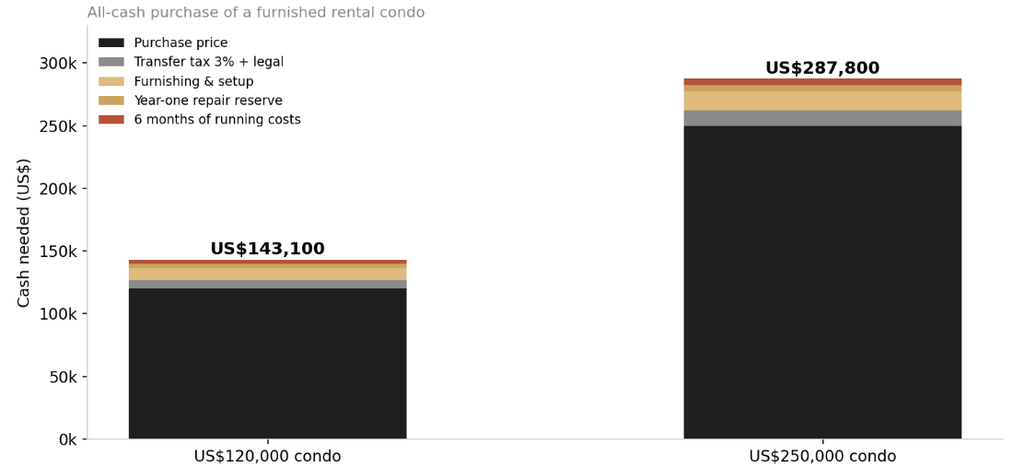
For an all-cash purchase, budget about 15% above the price for taxes, legal fees, furnishing, a repair reserve, and six months of running costs. A US$120,000 condo needs roughly US$143,000.
Dominican banks lend to foreigners, but rates averaged 11.93% in January 2026. At that rate, a typical rental produces negative cash flow every month.
Pre-construction costs less, but you pay for years before you collect any rent, and delays are common. A finished unit costs more and earns from the first month.
A budget of US$20,000 to US$30,000 is not enough for a rental in a tourist area. It fits saving, a smaller long-term rental outside tourist zones, or waiting until you have enough reserves.
Jump to the 10-year model · taxes · is it safe? · Cap Cana ROI
What Real Estate Investment ROI Can You Realistically Expect?
Most listings quote gross yield, which is annual rent divided by the purchase price. Gross yield ignores vacancy and every cost of owning the property. The chart below shows how a 10% advertised yield shrinks once you apply realistic occupancy and real operating costs.
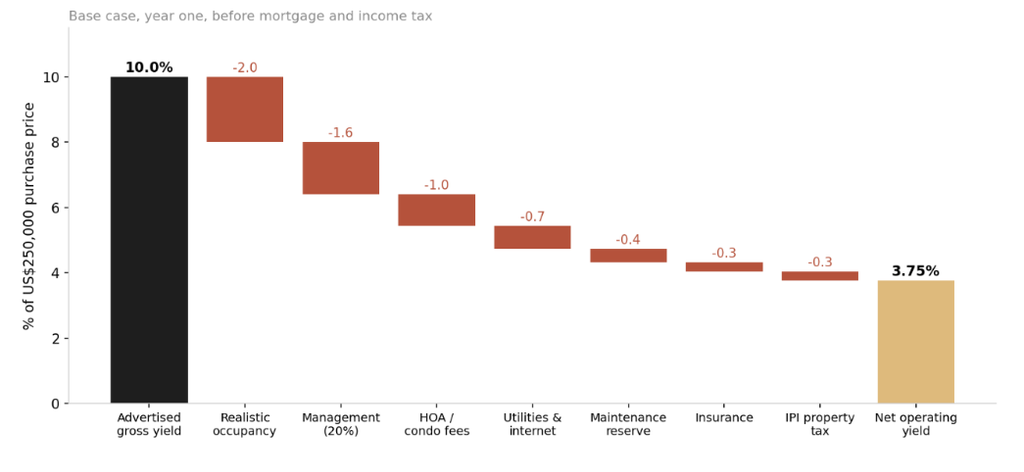
The biggest cuts come from occupancy and management. A unit that books well from December to April can sit half empty from September to November, and full-service managers commonly charge around 20% of rental revenue. Building fees and utilities then take a fixed amount every month, whether guests book the unit or not.
These figures come before mortgage payments and income tax. They also assume the owner never uses the property. Every week you block for your own vacation reduces the rent you can earn.
How Much Money Do You Need to Start?
The purchase price is only part of the cash you need. Buyers who budget only for the price often run short on furniture, repairs, and the months when the unit sits empty.
| Cost | US$120,000 condo | US$250,000 condo |
|---|---|---|
| Purchase price | US$120,000 | US$250,000 |
| Transfer tax (3%) | US$3,600 | US$7,500 |
| Legal and registration | US$3,000 | US$5,000 |
| Furnishing and setup | US$10,000 | US$15,000 |
| First-year repair reserve | US$3,000 | US$5,000 |
| Six months of running costs | US$3,500 | US$5,300 |
| Total cash needed | About US$143,100 | About US$287,800 |
DGII, the Dominican tax authority, applies a 3% property transfer tax to the higher of the sale price or its own assessed value. Approved CONFOTUR projects can exempt the first buyer from it.
Owners who recently took delivery of new units often report spending several thousand dollars on fixes and missing items in the first year. That is why the model includes a first-year repair reserve. Quote your own furnishing and repair costs before you rely on these estimates.
Who Should Not Buy Yet
Before you invest in Dominican Republic real estate, consider waiting if any of these describe your situation.
- You would need a personal loan or credit cards to cover part of the purchase.
- You have no cash left for six months of costs after closing.
- The deal only works if the unit books at peak-season rates all year.
- You cannot visit the country to sign documents and inspect the property.
- You have no trusted manager on the ground.
If your budget is smaller, compare cheap houses for sale in the Dominican Republic and the affordable properties young professionals rent before you commit. Waiting and saving is also a legitimate investment decision. Money in a savings account earns a guaranteed return with no vacancy, repairs, or currency risk, so a property needs to beat that comfortably to justify the extra work.
Can You Finance a Dominican Property?
US banks generally do not lend against property in another country, so foreign buyers usually choose between a Dominican mortgage, a developer payment plan, or cash.
Dominican banks do lend to foreigners, but the terms are expensive. The Central Bank reported an average mortgage rate of about 11.93% in January 2026. Buyers commonly report making 30% down payments, spending months on paperwork, and needing to sign in person.
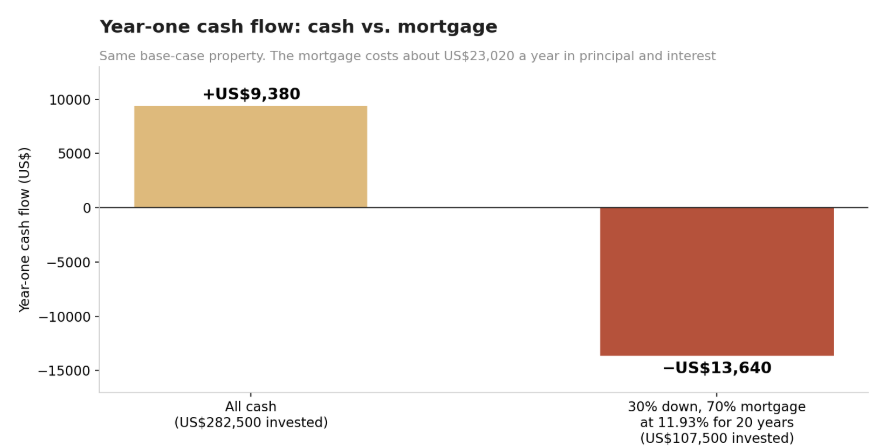
In this example, the same property earns about US$9,380 in its first year when bought with cash. With a 70% mortgage at 11.93% over 20 years, the annual loan payment is about US$23,020, so the owner pays roughly US$13,640 out of pocket each year. A mortgage only helps when the property earns more than the loan costs.
Personal loans are usually worse. They carry higher rates and much shorter terms than mortgages, so the monthly payment can be several times what the property earns. Our guide to calculating mortgage payments in the Dominican Republic shows how to check any loan offer.
Pre-Construction vs. Finished Resale
Pre-construction units usually sell below the price of finished units, and developers spread payments over the build. The catch is timing. You pay for years before you collect any rent, and delivery delays of six months to two years are common.
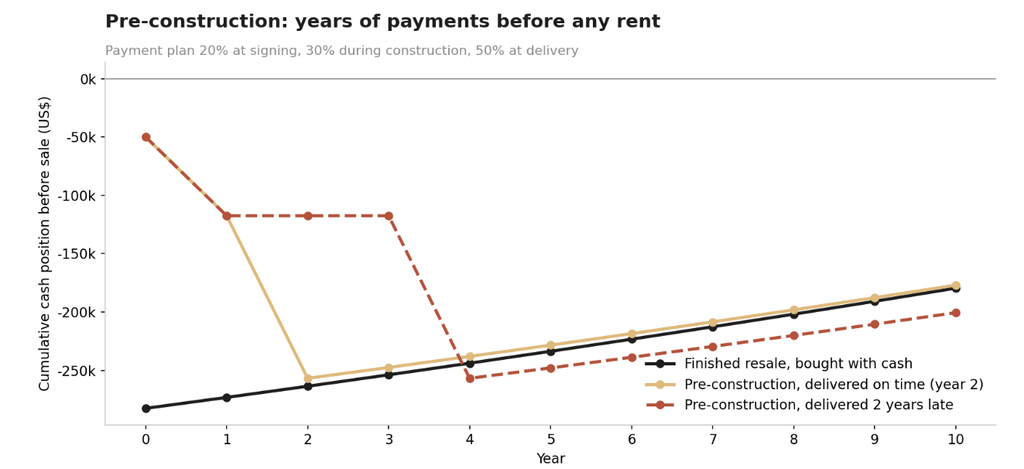
In the chart, the pre-construction unit costs 10% less and follows a common plan of 20% at signing, 30% during construction, and 50% at delivery. Delivered on time, it catches up with the resale unit. Delivered two years late, the buyer has US$117,500 tied up for four years with no income, and finishes the decade about US$20,000 behind.
Developer price increases before construction finishes are not the same as market appreciation. A price list that rises every few months shows what new buyers pay. It does not show what you could sell your unit for.
How to Reduce Pre-Construction Risk
- Choose a developer with finished projects you can visit and owners you can talk to.
- Ask whether payments go into a trust structure (fideicomiso) and what it actually protects.
- Write delivery dates, delay penalties, specifications, and refund terms into the contract.
- Make sure you can cover the final payment even if a mortgage falls through.
- Budget for finishing problems after delivery.
Approved tourism projects may also qualify for CONFOTUR tax benefits, which you can confirm through the Tourism Ministry’s CONFOTUR system. Our CONFOTUR guide explains why these benefits usually apply only to the first buyer from the developer.
The 10-Year Real Estate Investment ROI Model
The model below follows one US$250,000 condo bought with cash, held for 10 years, and then sold. It is illustrative, not a forecast for any listing.
| Assumption | Conservative | Base case | Upside |
|---|---|---|---|
| Booked rent, year one (% of price) | 6% | 8% | 10% |
| Management fee | 20% of rent | 20% of rent | 20% of rent |
| HOA, utilities, and insurance | US$4,900 a year, rising 3% a year | US$4,900 a year, rising 3% a year | US$4,900 a year, rising 3% a year |
| Maintenance reserve | 5% of rent | 5% of rent | 5% of rent |
| IPI property tax | 1% above the 2026 threshold | 1% above the 2026 threshold | 1% above the 2026 threshold |
| Rent growth | 1% a year | 2.5% a year | 3% a year |
| Appreciation | 1.5% a year | 3.5% a year | 5% a year |
| Selling costs | 6% of sale price | 6% of sale price | 6% of sale price |
| Capital gains tax | 10% of the gain | 10% of the gain | 10% of the gain |
| Result | Conservative | Base case | Upside |
|---|---|---|---|
| Total cash invested | US$282,500 | US$282,500 | US$282,500 |
| Year-one net operating income | US$5,630 | US$9,380 | US$13,130 |
| Year-one cash return on total cash | 2.0% | 3.3% | 4.6% |
| 10-year net rental income | US$55,176 | US$102,955 | US$147,736 |
| Sale price in year 10 | US$290,135 | US$352,650 | US$407,224 |
| Capital gains tax at sale | US$1,023 | US$6,899 | US$12,029 |
| Total 10-year profit | US$44,380 | US$145,047 | US$235,997 |
| Annualized return (IRR) | 1.6% | 4.8% | 7.4% |
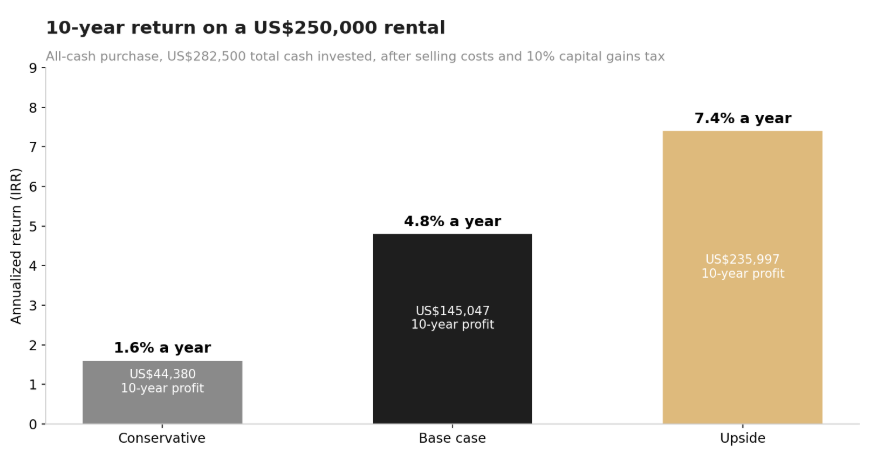
The base case turns a 10% advertised yield into about a 4.8% annualized return over 10 years. That is positive, but it is not the double-digit figure many brochures suggest. The conservative case barely beats a savings account, with far more risk and work.
Appreciation drives much of the result. Some owners report strong price growth in established communities, while others say prices in parts of Punta Cana barely moved for years because new supply kept arriving. Treat appreciation as a scenario, not as income.
Stress-Test Your Own Numbers
- Cut rental revenue by 10% to 15%.
- Add six months of unexpected vacancy.
- Add a special building assessment.
- Assume no appreciation for the first three years.
- Assume the sale takes a year longer than planned.
- Raise the interest rate if you finance.
If the property still meets your target after these tests, the numbers are worth a closer look. If it only works in the upside case, walk away.
Taxes That Change Your Return
Dominican tax law changed in 2026, and older guides may be out of date. These are the main points that affect a rental investment. Confirm your own position with a Dominican accountant.
| Tax | What applies | Source |
|---|---|---|
| Transfer tax | 3% of the higher of the price or DGII’s assessed value, paid once at purchase | DGII |
| IPI property tax | 1% a year on an individual’s taxable real estate above RD$10,695,494 in 2026 | DGII 2026 IPI guide |
| Capital gains on sale | 10% of the gain for individuals, effective since June 2026 | Law 30-26 |
| Withholding on rent | Rent paid to individuals by companies or other withholding agents now faces 15% withholding, up from 10% | Law 30-26 |
| CONFOTUR | Can exempt qualifying first buyers from transfer tax and IPI in approved projects | Ministry of Tourism |
Rental income tax depends on where you live and how you own the property. A property held by a non-resident, a Dominican company, or a resident individual can face very different treatment, so this is the line most worth reviewing with an accountant before you buy.
Short-Term or Long-Term Rental?
Your rental strategy changes the return as much as the location does.
| Long-term rental | Short-term rental | |
|---|---|---|
| Typical areas | Santo Domingo, Santiago, Higüey | Punta Cana, Las Terrenas, North Coast |
| Income | Lower but steadier | Higher but seasonal |
| Management | Light | Heavy, with cleaning and guest service |
| Wear and tear | Lower | Higher |
| Main risk | Low rent compared with the price | Vacancy and competing listings |
Many buyers rent first to test an area. Knowing how to find apartments in the Dominican Republic, and what to look for in apartments for rent, makes that trial far more useful. Long-term rents outside tourist areas are modest compared with property prices, so long-term rentals often take many years to repay the purchase. Short-term rentals can earn more, but only with good management and a location that books outside high season. The Samaná peninsula, for example, is busy during whale season and Easter and much quieter in other months.
Compare listings by community, price, and distance to the beach before you run your own numbers.
Compare Dominican Republic PropertiesCap Cana Investment Property ROI
Cap Cana is the country’s best-known luxury community, with a marina, golf courses, beach clubs, and gated security. Local agents reported 2-bedroom pre-construction units there from about US$380,000 to US$450,000 in late 2025, according to our guide to the best places to invest in Dominican Republic real estate.
Higher prices usually bring higher community fees, so a Cap Cana investment property often earns a lower cash yield than a mid-range condo in Bávaro. Buyers accept that trade for privacy, a recognized address, and steadier resale demand. Run the model above with the actual fee schedule, because a few hundred dollars a month in extra fees can cut the net yield by a full percentage point.
Our guide to how location and tourism shape Punta Cana prices explains why two similar units in different communities can perform very differently.
How to Evaluate a Specific Project
Whether you are looking at Maraluna or any other development, evaluate the project with the same real estate investment ROI checks before you reserve a unit. A polished brochure and a projected yield are not evidence.
- Check the developer’s finished projects and talk to current owners about delivery and quality.
- Ask for real rental data from completed units in the same development, month by month.
- Get the full fee schedule, including HOA, management, and rental program splits.
- Confirm the CONFOTUR resolution if the seller promises tax benefits.
- Have an independent lawyer verify the land title, permits, and payment protections.
- Run the project through the conservative case, not only the advertised yield.
Managing a Rental From Abroad
Most investors live overseas, so the manager decides whether the numbers work. A family member can manage well, but treat the arrangement like a business.
- Put the fee, duties, and reporting schedule in writing.
- Ask for monthly statements with bookings, expenses, and receipts.
- Keep the property insured and protected when it is empty.
- Agree who approves repairs and up to what amount.
- Confirm that the building allows short-term rentals before you list it.
Is It Safe to Invest in Dominican Republic Real Estate?
Foreigners can own titled property in their own name, and thousands of buyers complete purchases every year without problems by following the standard steps for buying property in the Dominican Republic.
Risks That Owners Report
These risks do not make Dominican real estate a bad investment, but each one belongs in your budget or your contract.
- Title delays. Some buyers wait months or years for a clean title. An independent lawyer should check the title and liens before you pay.
- Construction quality. Finishing work such as windows, plumbing, and tiling can need repairs soon after delivery.
- Oversupply. Punta Cana and Cap Cana have a lot of new construction, so your unit competes with many similar ones.
- Condominium rules. Condo governance relies on an older legal framework, and disputes with other owners or the administrator can be slow to resolve.
- Currency. The peso has gradually weakened against the dollar over time, so peso rent and peso interest rates can lose value in dollar terms.
- Liquidity. Resale can take months, especially for properties aimed only at foreign buyers. Clear pricing and strong property descriptions help when you sell, and our guide on why some listings sell faster covers the exit side.
Each of these risks belongs in your budget, your contract, or your list of questions for the seller.
What to Ask For Before You Buy
- Twelve to 24 months of month-by-month booking and revenue data for the unit or comparable units.
- The management contract, including every fee and what it covers.
- The building budget, HOA fees, and any planned special assessments.
- The CONFOTUR resolution, if the seller claims tax benefits.
- The certificate of title and a current lien report.
- Recent resale prices and time on market for similar units in the building.
A seller who can only provide a polished annual average, and no monthly data, is asking you to trust the number without evidence. You can also screen listings online before you travel.
Is It Better Than Other Investments?
Compare any Dominican Republic property investment with what the same money could earn elsewhere. A base-case return of about 4.8% a year needs to beat a savings account, a bond fund, or a rental closer to home after you account for the extra risk, the work of managing from abroad, and the time it takes to sell.
For many buyers, a Dominican property makes the most sense as a part-time home that pays some of its own costs, rather than as a pure income investment. That is a valid goal, as long as you buy with that expectation. If you plan to live there part of the year, our guide to moving to the Dominican Republic from the US covers residency and living costs. Investors who prefer business tenants can also look at triple net leases in the Dominican Republic, where the tenant pays most property costs.
Build Your Real Estate Investment ROI Before You Buy
A realistic real estate investment ROI starts with honest numbers. The best investment is not the one with the highest advertised yield. It is the one whose price, rent, costs, taxes, financing, and resale still work when you test the weaker outcomes.
Start with your budget and goal, run the numbers with real quotes, and have an independent lawyer and accountant review the deal. Roof360 lets you compare listings by location and price so you can build a shortlist with realistic numbers.