Cheap houses for sale in the Dominican Republic often start around US$85,000 to US$125,000 outside the main tourist zones. Compare them by price and area on Roof360’s map, then verify the title before you pay.
How do you find a genuinely affordable house in the Dominican Republic without buying someone else’s expensive problem? Start by separating the low price from the real cost.
A cheap house can be a smart buy, like an older home in a busy Santiago neighborhood or a small apartment in Santo Domingo Este. It can also be a trap, like a house with an inheritance dispute, no survey, or a roof that needs replacing. The difference rarely shows in the listing photos, so this guide shows you where the lower prices are, what houses actually cost, and how to check a bargain before you commit.
Quick takeaways
Cheap houses outside the tourist zones often start around US$85,000 to US$125,000, or about RD$5 million to RD$8 million.
Your real budget is the price plus about 5% in closing costs, plus repairs and furniture.
Bank-owned homes exist, but banks usually sell near market value through bids.
There is no public record of sale prices, so a bank-grade appraisal is your best value check.
Local buyers often put about 20% down, while foreign buyers usually need 30% to 50%.
Start with what houses cost in each area, then follow the steps to find real value. If you want the lowest prices, the sections on bank-owned homes and how to check what a house is worth show where bargains hide, and the section on down payments helps you plan the money.
How Much Does a House Cost in the Dominican Republic?
Prices vary more by area than by size. The examples below come from current listings and published projects, converted at about RD$62 per US dollar, the Central Bank reference rate in October 2026.
| Area and type | Starting price in dollars | Starting price in pesos |
|---|---|---|
| Santiago, compact apartment | About US$82,000 | About RD$5.1 million |
| Santiago, 3-bedroom house | About US$120,000 | About RD$7.5 million |
| North coast, studio near the beach | About US$85,000 | About RD$5.3 million |
| Santo Domingo Este, new apartment | About US$126,000 | About RD$7.8 million |
| Bayahibe, pre-construction studio | About US$98,000 | About RD$6.1 million |
| Punta Cana, 1-bedroom condo | About US$120,000 | About RD$7.4 million |
| Government low-cost housing ceiling | About US$88,000 | RD$5.45 million |
Treat these as starting points, not appraisals. Asking prices often sit above what homes really sell for, which the section on checking real value explains. For a closer look at one city, our guide to investing in Santiago de los Caballeros breaks down current listings by type and size.
How to Find Cheap Houses for Sale in the Dominican Republic
These steps help you find cheap houses for sale in the Dominican Republic that still make sense after you check every number and document.
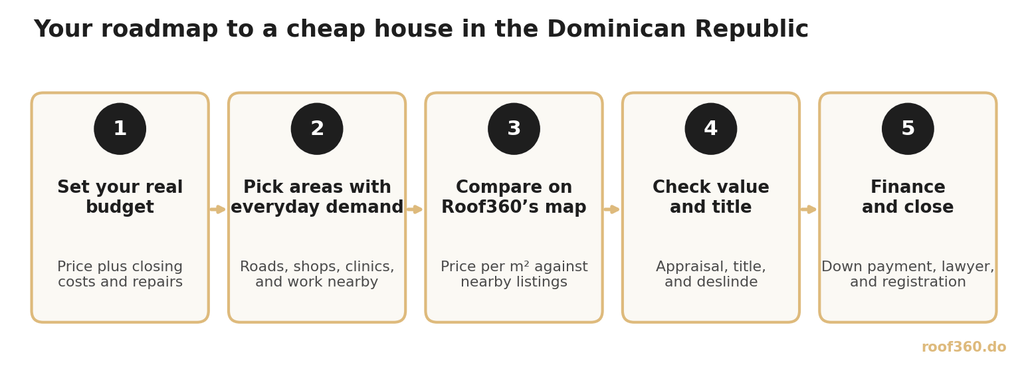
1. Set Your Real Budget, Not Just the Price
Your budget is the price plus about 4.5% to 5.5% in closing costs, any repairs, furniture, and a few months of running costs. A house listed at US$100,000 can easily need US$110,000 to US$115,000 in cash before you move in.
Decide early what the house needs to do for you. A family home, a long-term rental, and a fixer-upper to resell all point to different areas and different houses.
2. Pick Areas With Everyday Demand
The lowest sensible prices usually sit outside the beach strips, in neighborhoods people live in all year. Look for places close to main roads, supermarkets, schools, clinics, and work. A modest house in a working neighborhood often holds its value better than a pretty one in an isolated spot with poor roads.
Good places to start include Santo Domingo Este and Santo Domingo Norte, the outskirts of Santiago, residential La Romana away from the resorts, San Cristóbal, and Puerto Plata neighborhoods away from the beach. The section on where to find the lowest prices covers more areas by buyer type.
3. Compare Listings on Roof360’s Map
A listing card shows a price and some photos. A map shows the context that explains the price. On Roof360, you can see each house on the map, compare it with nearby listings, and contact the owner or agent directly.
Compare the price per square meter, not just the total. A RD$7.5 million house with 180 m² costs about RD$41,700 per m², while a RD$5 million house with 90 m² costs about RD$55,500 per m². The bigger house is the better deal per meter, even though its price is higher.
4. Look at Older Listings and Cosmetic Fixers
Houses that have been online for months often have room to negotiate, especially when the photos are poor or the description is thin. Old paint, dated tiles, and an ugly kitchen are fixable. Roof damage, drainage problems, foundation cracks, and illegal extensions are not cheap fixes, so walk away or price them in. Our guide on how property descriptions shape buyer decisions explains why good homes sometimes hide behind weak listings.
5. Check the Title, Survey, and Debts
A low price never replaces legal checks. Your lawyer should confirm the certificate of title, any liens or lawsuits, unpaid taxes, and whether the seller has the right to sell. Ask specifically about the boundary survey, called a deslinde. Cheap rural land and older family houses often lack one, and land held only under a constancia anotada, a share of a larger parcel, carries more risk. Our guide to buying property in the Dominican Republic walks through every legal step.
6. Score the House Before You Visit
Rate each house from 1 to 5 on price per m², location, title clarity, repair risk, financing potential, and resale appeal. A house that scores high on price but low on title and repairs is not cheap. It is risky.
Bank-Owned and Foreclosed Homes
Some of the cheapest houses for sale in the Dominican Republic come from banks. Dominican banks sell properties they repossess, called bienes adjudicados. Banreservas, BHD, and Banco Popular publish these homes on their own websites, and buyers search for them under the name remate bancario.
Expect fewer bargains than at a US foreclosure sale. Many banks sell through bids or auctions to the highest offer, so prices often land closer to market value than buyers hope. Some banks offer financing on their own repossessed homes, which can make the purchase easier.
Check these homes as carefully as any other. Confirm that the bank holds a clean title, find out whether anyone still lives in the house, and inspect it in person, because many repossessed homes sat empty and need repairs.
How to Check What a House Is Really Worth
The Dominican Republic has no national property website or public record of sale prices. Listing sites show asking prices, and some owners list at the price they hope for rather than what the market pays. Even professional appraisers here rarely work from comparable sales the way US appraisers do.
You can still build a fair picture of value.
Order a bank-grade appraisal. A tasación from an appraiser who works with the major banks gives you a solid starting number for negotiation.
Compare price per m² nearby. Check similar homes on the same street or in the same building.
Ask the neighbors and the building manager. They often know what recent units really sold for.
Check whether the land is worth more than the house. In central Santo Domingo, an old house on a large lot can be worth far more to a developer than as a home. One owner described a small old house on his street that sold as a lot for about RD$22 million, several times its value as a house.
This works in both directions. If your family owns a house in Santo Domingo and plans to sell, the same checks help you set a realistic price, and our guide on why some listings sell faster explains how to present it.
Low-Cost Housing and First-Home Support
The government defines a low-cost home, or vivienda de bajo costo, by a price ceiling. For 2026, news reports put that ceiling at RD$5,450,851.12, about US$88,000. Homes in qualifying projects can carry benefits such as transfer-tax relief, but only when the project and the buyer meet the program rules, so a cheap listing does not qualify on price alone.
Dominican families buying their first home may qualify for the Mi Vivienda program, including a first-home down payment bonus. If you are an overseas Dominican with a cédula, ask whether you qualify, because benefits that a foreign spouse cannot use may still be open to you.
Is a House or an Apartment Cheaper to Own?
Many buyers searching for cheap houses for sale in the Dominican Republic end up comparing them with apartments, and the answer depends on how you want to live.
Apartments often cost less to maintain day to day. Many buildings include security, a water tank, a backup generator, and staff who handle trash and repairs, paid through a monthly fee. Houses give you land, a yard, and room to grow, and many Dominican homes can take a second floor later. Every repair is yours, though, from the water pump to the roof.
If you plan to rent, apartments in managed buildings are usually easier to run from abroad. If you want space for a family or a garden, a house outside the city center often gives you more for the same money. Our guide to affordable properties for young professionals compares smaller options in the cities.
How Much Down Payment Do You Need?
The down payment depends on who lends and what you buy.
- Local bank mortgage on a finished home. Dominican buyers often put down about 20%, and many listings in Santiago advertise that figure.
- Foreign buyers. Banks commonly ask foreigners for 30% to 50% down.
- Pre-construction. Developers usually ask for 10% to 20% at signing, payments during construction, and the balance at delivery. High-end communities such as Cap Cana tend to ask for larger amounts up front because the prices are higher.
Banks usually ask for your passport or cédula, a job letter, recent bank statements, and your latest tax return if you live abroad. One detail catches many buyers. Banks lend on the appraised value of the empty house, so if the seller includes furniture in the price, you pay for the furniture in cash. Our guide to calculating mortgage payments in the Dominican Republic helps you test the monthly cost.
Where to Find the Lowest Prices
The right area depends on whether you want to live, rent, or retire.
- For city living on a middle-class budget. In Santo Domingo, look at Bella Vista, Evaristo Morales, El Millón, Gazcue, and Alma Rosa. Piantini and Naco cost more. Our Santo Domingo real estate guide compares the neighborhoods.
- For a quieter, cheaper life. Santiago and the Cibao towns, including Moca and San José de las Matas, plus San Juan and Jarabacoa, offer more house for the money.
- For beach access at a lower price. San Pedro de Macorís and Puerto Plata city, including Costambar and Los Olivos, cost less than Punta Cana or Las Terrenas.
- For long-term growth. Emerging areas near new roads, schools, and hospitals can rise in value, though they carry more risk.
When a Cheap House Turns Expensive
A few situations explain most of the bad deals.
- Abandoned homes with family titles. Many cheap abandoned houses belong to an estate with several heirs, called a sucesión. Every heir must sign, so never buy from one family member alone.
- Land without a survey. Rural plots without a deslinde cause most boundary disputes.
- Buying land to build later. Some buyers build in stages to save money. Check road access, water, and power before you buy, because bringing them to the lot can cost more than the land.
- Hidden repairs. Leaks, cracks, and old wiring cost far more than cosmetic updates.
- Paying before checking. Never send a deposit before your lawyer confirms the title.
Find a Cheap House That Still Makes Sense
The best cheap houses for sale in the Dominican Republic combine a fair price with a clean title, a practical location, and repairs you can afford. Buyers who compare the full cost find stronger deals than buyers who chase the lowest number.
Start your search on Roof360, compare houses by area and price on the map, and bring your shortlist to a lawyer before you make an offer.