
A marina apartment and a villa overlooking a fairway serve different ownership plans in Cap Cana. Their asking prices, maintenance obligations, rental rules, and eventual buyers need separate assessment before you commit.
The strongest Cap Cana real estate opportunities fit a clear purchase purpose and a budget that survives quieter rental periods. Start with the address, ownership documents, and operating costs behind the advertised lifestyle.
Decide What the Investment Must Deliver
Cap Cana combines residential communities with beaches, golf, marina facilities, hotels, and everyday services in La Altagracia. Identify whether your priority is personal use, rental income, or a property you will eventually occupy.
Allow for Personal Use in the Income Plan
A holiday home used during desirable booking dates needs a rental forecast that excludes those stays. Record your expected visits first, then calculate the nights available to paying guests each year.
For buyers moving to the Dominican Republic from the United States, daily travel and access to schools or healthcare can shape the housing decision. Test those requirements during a stay before deciding which part of Cap Cana suits you.
When comparing Cap Cana real estate opportunities, choose a target holding period and an acceptable annual cash commitment. This gives you a useful basis for comparing an apartment, villa, or development lot.
Understand Cap Cana’s Locations and Infrastructure
The address within Cap Cana determines the facilities and routes you will actually use. Compare the property’s position with its asking price, then inspect access arrangements and surroundings at different times.
Compare Marina, Beach, Golf, and Residential Settings
The relationship between location and property prices becomes clearer when comparable homes serve similar owners or guests. Match the neighborhood, property type, condition, and included privileges before judging the premium attached to an address.
| Setting | Features to inspect | Rights and costs to confirm |
|---|---|---|
| Marina area | Waterfront position, dining access, pedestrian routes | Mooring arrangements, parking, guest access, building fees |
| Juanillo and coastal locations | Beach route, frontage, views, exposure | Documented access, club conditions, insurance, maintenance |
| Punta Espada and Las Iguanas surroundings | Actual golf position, privacy, nearby construction | Membership terms, landscaping obligations, rental rules |
| Las Canas and residential locations | Daily services, roads, school and work journeys | Exact development boundaries, utilities, community charges |
Check What Recent Infrastructure Changes Mean for the Unit
Cap Cana’s August 2026 central boulevard update describes an opened four-lane connection serving hotel and residential areas. Inspect the route from your chosen property, including traffic, access points, and nearby construction, before estimating its benefit.
Cap Cana real estate opportunities should be evaluated against the infrastructure available to the purchased phase. Separate completed services from future commitments in the contract, particularly where surrounding plots remain under development.
Match the Property Type to Your Capital and Responsibilities
Compare properties in Cap Cana and La Altagracia using the same requirements for location, condition, and ownership costs. Apartments, villas, and lots create different commitments, even when they share a destination name.
Apartments and Villas Require Different Maintenance Budgets
When comparing Cap Cana condos for sale, include the unit and shared infrastructure, including roofs, elevators, pools, and utility systems. Request condominium accounts, reserves, maintenance history, and proposed assessments before negotiating.
Cap Cana villas for sale need a budget for private buildings, gardens, pools, equipment, and community charges. Inspect cooling systems, waterproofing, drainage, and service areas, then price repairs before making an offer.
Use Asking Prices as Individual Purchase References
Two of our listings have these asking prices. Each figure belongs to a different advertised property; confirm availability, specifications, payment currency, and the seller’s final quotation.
| Advertised property | Bedrooms | Displayed asking price |
|---|---|---|
| Cana Essence at Cap Cana apartment | 1 | RD$13,864,809 |
| Las Iguanas Golf Residences villa | 3 | RD$41,339,750 |
These examples help frame the capital involved in different Cap Cana real estate opportunities. Establish value through comparable properties and documented transactions, with land, built area, condition, and included services assessed separately.
Review Lots and Pre-Construction Contracts Carefully
For a lot, confirm permitted use, construction restrictions, utility connections, access, and any deadline or obligation to build. Include design, approvals, construction management, and holding costs in the total investment calculation.
Detailed online property checks can reveal missing unit information before a viewing or reservation. Request the development phase, floor plan, payment schedule, delivery specification, and contract remedies for changes or delayed completion.
Test the property against realistic bookings and complete ownership expenses before increasing your offer. Compare units with a consistent calculation for initial cash, annual costs, and the nights you intend to use personally.
Calculate Rental Returns Using the Property’s Own Numbers
Cap Cana real estate opportunities need income assumptions tied to the particular unit and rental arrangement. Request achieved rates, booking records, owner-use dates, and the management contract where those records exist.
Model All the Cash Needed to Begin Ownership
An investment model should include acquisition costs and the money needed to prepare the property for use. The following hypothetical apartment example illustrates the calculation without predicting the performance of any listing.
| Initial cash requirement | Illustrative amount |
|---|---|
| Purchase price | US$350,000 |
| Closing-cost allowance | US$14,000 |
| Furnishing and setup | US$18,000 |
| Total initial cash | US$382,000 |
The closing allowance is a planning assumption that needs replacement with transaction-specific quotations and confirmed tax treatment. It does not establish the fees or exemptions applicable to a particular buyer or property.
Test Booking Nights and Operating Expenses
Assume an achieved nightly rate of US$180, with 180 paid nights producing US$32,400 annually. Deducting US$14,000 in operating expenses leaves US$18,400 before financing and income tax, or approximately 4.82% of initial cash.
At 140 paid nights, revenue falls to US$25,200 and the same expense allowance leaves US$11,200. That represents approximately 2.93% of initial cash, with costs held constant solely to illustrate the effect of fewer bookings.
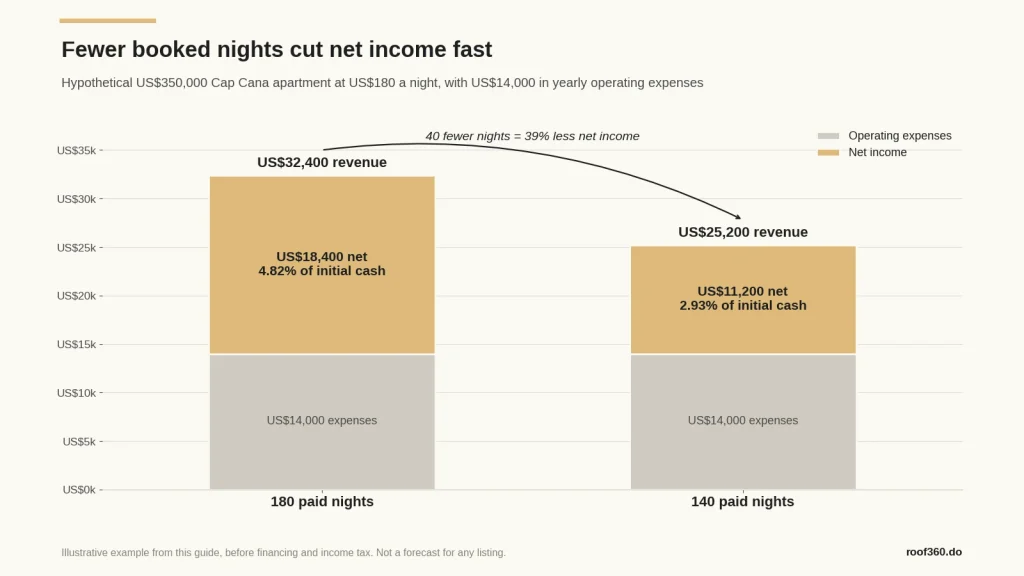
Build rental cash-flow projections with separate entries for management, community charges, utilities, maintenance, insurance, and applicable property taxes. Allow expenses to vary realistically when booking volume changes, and include replacement furnishings over the holding period.
Account for Your Own Stays
Personal use reduces the nights available to guests and may affect the achievable annual rental mix. For Cap Cana real estate opportunities, calculate the return using your intended calendar before relying on advertised occupancy.
Verify Ownership and Contract Terms Before Paying a Reservation
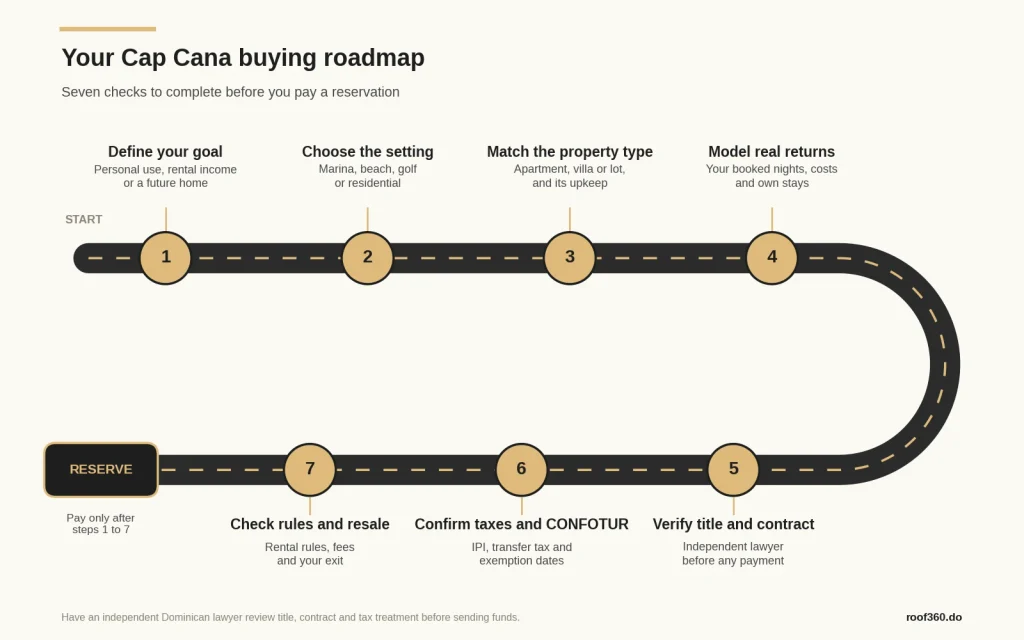
Foreign individuals can buy Dominican property, with the transaction still requiring appropriate documentation and registration. Use independent counsel to review the chosen property, seller authority, and purchase terms before sending funds.
Connect the Advertised Unit to Registered Documents
Before buying property in the Dominican Republic, have counsel examine the title and obtain a current certification of the property’s legal status. Check recorded owners, charges, and litigation against the unit being offered.
Cap Cana real estate opportunities also require checks beyond registered ownership. Review boundaries, condominium documents, relevant permits, unpaid community balances, and the seller’s ability to transfer the property under the proposed terms.
Put Payment Conditions and Delivery Remedies in Writing
The reservation agreement should identify the unit, seller, payment recipient, amount, and refund conditions precisely. Ask counsel to document what happens if title checks, financing, or promised exemption approvals are unsuccessful.
For unfinished properties, connect payment milestones to clear contractual obligations and review the developer’s completed work. Record delivery dates, permitted specification changes, defect correction, and remedies for delay before accepting the schedule.
For a completed resale, arrange a physical inspection alongside the legal review and obtain written repair estimates. Confirm inclusions. Keep agreed corrections, outstanding balances, and handover conditions in the purchase documentation.
Confirm Financing, Property Taxes, and CONFOTUR Eligibility
The cost of Cap Cana real estate opportunities depends on the borrower, ownership structure, property assessment, and applicable exemptions. Keep confirmed financing and tax figures separate from allowances used during the initial search.
Use the Lender’s Actual Financing Terms
Accurate mortgage payment calculations require the quoted rate, loan currency, repayment term, insurance, and charges. Test payments against reliable income, then consider how a rate adjustment or currency movement could affect affordability.
Calculate Annual IPI Against Your Taxable Holdings
The DGII’s January 2026 IPI guidance sets the individual exemption threshold at RD$10,695,494. Standard annual IPI applies at 1% above that threshold across combined taxable holdings, with specific exemptions requiring separate eligibility checks.
Purchase expenses also include applicable transfer tax, legal work, notarial and registration charges, and lender costs where relevant. Obtain a written closing estimate reflecting the property’s assessed value and the transaction’s confirmed treatment.
Confirm the Approved Benefit and Remaining Period
Qualifying first purchasers in approved tourism projects may receive CONFOTUR transfer-tax and IPI relief. Request the relevant resolution and buyer authorization requirements, then have counsel confirm coverage of the unit and transaction.
The amended framework provides a fifteen-year exemption period tied to completion of project construction and equipping. Establish the documented dates. A purchase or resale does not automatically begin a fresh fifteen-year term.
Treat any promised rental income-tax exemption as a transaction-specific tax question when assessing Cap Cana real estate opportunities. The approved activity, taxpayer, ownership structure, and required authorization should support the treatment used in your forecast.
Build your shortlist around the routes, facilities, and costs that matter to your ownership plan. Request exact property locations before comparing advertised beach, marina, or golf access across different developments.
Check Management Agreements and Owner Access Rights
A rental arrangement needs clear responsibilities for bookings, guest support, repairs, and owner payments throughout the year. Cap Cana real estate opportunities should be assessed alongside the conditions governing how the property operates.
Obtain the Rules for the Specific Development
Ask the administrator to confirm rental permissions, minimum stays, guest registration, and any required management operator. A seller’s description of a unit as suitable for short-term rentals needs support from the applicable documents.
- Identify community and condominium fees separately where both apply.
- Confirm charges for memberships, guests, parking, and amenity access.
- Review management commissions and repair approval limits.
- Establish owner-use restrictions and cancellation conditions.
- Request reporting, payment, and contract termination terms.
Owning an apartment near the marina does not establish a right to a berth or marina services. Golf and beach-club privileges require their own written confirmation, including charges and transfer conditions when ownership changes.
Plan the Resale Before Choosing the Purchase
Compare Cap Cana real estate opportunities with the buyers who could realistically purchase the unit later. Consider its ongoing charges, condition, documentation, and competing supply alongside the price you hope to achieve.
Comparing Punta Cana real estate for sale reveals how your proposed purchase competes across the wider destination. Keep asking prices distinct from completed transactions, and request evidence supporting assumed appreciation in the exit calculation.
Include Selling Costs and Current Capital Gains Treatment
The DGII’s June 2026 implementation calendar lists an immediately effective 10% rate for individuals’ real estate capital gains under Law 30-26. Have an adviser verify the taxable gain, applicable exemptions, and seller-specific treatment.
Deduct selling commissions, legal expenses, outstanding debt, taxes, and repair allowances when estimating your proceeds. Retain purchase and improvement records. Update the resale calculation when an actual offer and sale date are available.
Choose a Cap Cana Purchase You Can Support With Numbers
The most suitable Cap Cana real estate opportunities align the property’s location and documents with your budget and intended use. Confirm the running costs, rental conditions, and tax treatment before deciding what to offer.
An investment decision becomes easier to assess when the income model, legal checks, and exit assumptions concern the same unit. Keep the supporting documents together and resolve material gaps before committing funds.
Roof360 helps you explore Dominican Republic real estate by location and asking price, then connect with listing owners or agents. Build a Cap Cana shortlist and arrange independent verification for properties meeting your criteria.